
Why Is Three Heads Embroidery Machine The Best Choice For Medium-Scale Embroidery Factories In 2026?
Abstract
Global embroidery processing industry is undergoing intensive digital transformation amid fast-growing apparel, home textile and handicraft market demands, pushing medium-sized embroidery manufacturers to upgrade outdated single-head production equipment constantly.Industry data from global textile machinery association and China embroidery machinery industrial cluster is cited to verify why mainstream medium factories gradually shift procurement focus toward this mature multi-head embroidery equipment, meanwhile introducing standardized production and global supply service from leading Chinese embroidery machinery producer to help overseas buyers reduce procurement risk and optimize long-term production layout.
Article Directory (Click text to jump to corresponding content)
1. Current Development Status & Demand Trend of Global Medium-Size Embroidery Manufacturing Industry
6. Global Market Supply Layout & Qualified Chinese Equipment Manufacturer Introduction
7. Key Purchasing Standards & Certification Check List For Overseas Equipment Importers
8. Future Technical Evolution Trend of Three-Head Computer Embroidery Machinery In Next Five Years
9. Frequently Asked Questions From Global Embroidery Factory Purchasers
1. Current Development Status & Demand Trend of Global Medium-Size Embroidery Manufacturing Industry
Starting from post-pandemic market recovery in 2023, global apparel, fashion accessory and home textile industries have maintained steady annual growth, bringing continuous incremental orders for downstream embroidery processing manufacturers across Southeast Asia, North America, Middle East and Latin America.
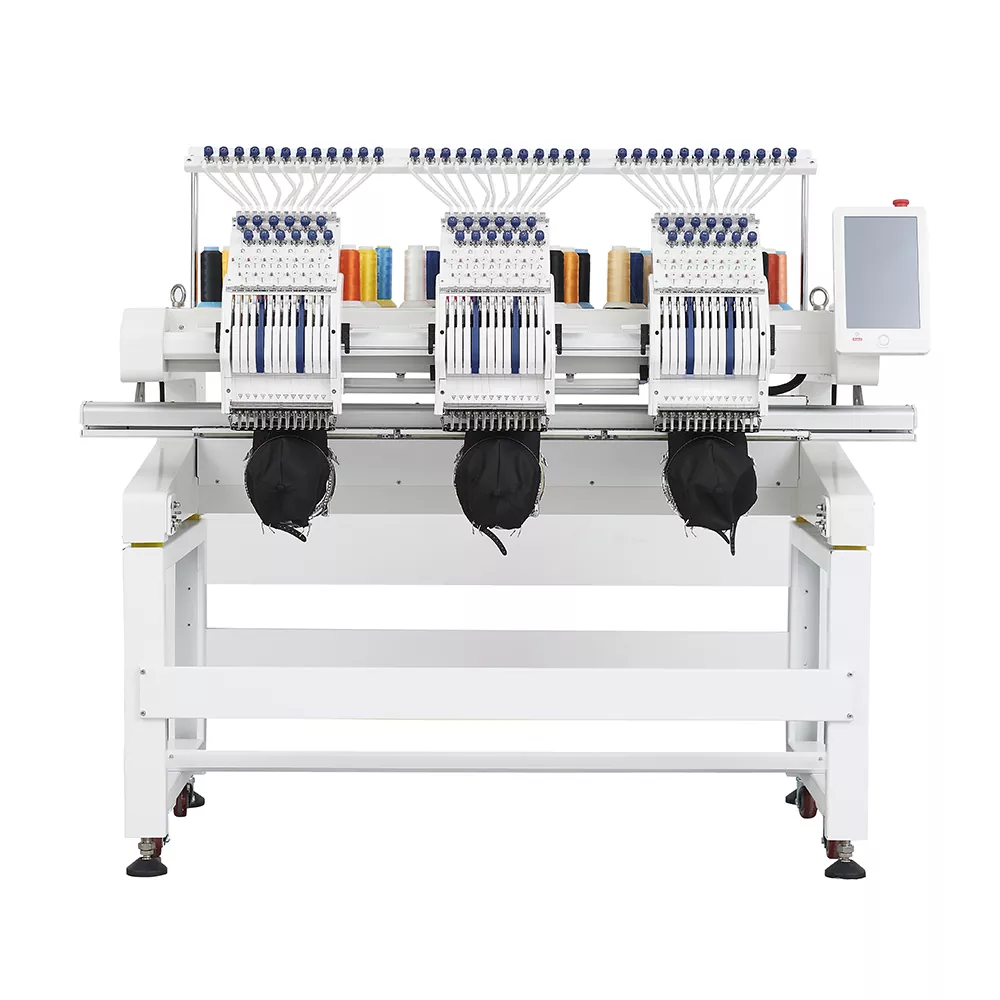
Under such industry background, Three Heads Embroidery Machine emerges as mainstream upgrade option for most medium factories, matching their production scale and budget planning perfectly.
According to official statistics released by International Textile Manufacturers Federation (ITMF) early in 2026, global apparel export volume increases by 7.2% year-on-year, while customized embroidered clothing, embroidered hat and home textile decoration orders rise over 11% annually.
Such remarkable order growth directly stimulates medium-scale embroidery processing factories to expand production capacity and optimize processing efficiency continuously.
Medium-sized embroidery factories, defined as production workshops with daily output ranging from 500 to 5000 finished embroidered products, occupy nearly 62% market share of global decentralized embroidery processing sector.
They act as core outsourcing suppliers for mid-tier fashion brands, local clothing retailers and home textile factories all over the world.
Different from large-scale industrial embroidery enterprises equipped with dozens of multi-head automatic embroidery machines and small family workshops using semi-manual embroidery tools, mid-size factories face unique balance pressure between production efficiency, equipment investment cost and flexible order adaptation capability.
In regional market segmentation, Southeast Asian nations including Vietnam, Indonesia and Bangladesh see explosive growth of small and medium embroidery processing factories driven by global fast fashion brand transfer.
North American and European local embroidery workshops focus on high-value customized embroidery for luxury apparel, sports accessories and handicraft souvenirs.
Both market segments require cost-effective, multi-functional automatic embroidery equipment to replace inefficient traditional machinery.
● Regional demand feature: Southeast Asian factories prioritize equipment with high continuous running stability and affordable purchasing price, while European and American buyers pay more attention to CE certification, multi-function compatibility and intelligent programming system of embroidery equipment, forming differentiated customized procurement needs for global machinery manufacturers.
● Order change trend: More than 68% mid-size embroidery enterprises receive mixed orders covering garment flat embroidery, cap curved embroidery and fabric patch embroidery, eliminating single-function equipment’s market competitiveness gradually and accelerating elimination of outdated single-head embroidery machinery from global production lines.
2. Core Defects of Traditional Single-Head Embroidery Equipment Restricting Factory Production Growth
For decades, single-head computer embroidery machine is basic production equipment for most newly-founded embroidery workshops thanks to low initial purchase cost and small space occupation.
However, with continuous expansion of factory order volume and diversification of embroidery product types, inherent structural and functional shortcomings of single-head embroidery equipment gradually expose obvious limitations blocking enterprise’s profit growth and business expansion in multiple dimensions.
● Low unit space utilization: To achieve equal daily output of three-head embroidery equipment, factories need to purchase three separate single-head embroidery machines, which occupy over 40% extra workshop area and require three independent professional operators for daily running.
Such condition significantly increases factory’s fixed cost on workshop rent and human resource expenditure month by month.
In regions with high industrial plant rental price such as Western Europe and Eastern US, such extra space cost becomes heavy financial burden restricting factory scale expansion directly.
● Inconsistent finished product precision: Different single-head equipment runs under separate control systems and mechanical aging degrees, finished embroidery patterns produced on multiple single-head machines exist tiny deviation on stitch density and pattern positioning.
It cannot meet uniform quality requirement of large batch brand order, resulting in frequent order return and loss of long-term cooperative brand clients for medium embroidery factories.
● Limited function expansion potential: Most entry-level single-head embroidery models only support basic flat fabric embroidery, lacking matched fixture and control module for cap curved embroidery, finished garment sleeve embroidery and bead embroidery transformation.
When factories receive mixed multi-type orders temporarily, they have to outsource partial processing work to other workshops, cutting down overall gross profit margin sharply and raising uncontrollable delivery risk of bulk orders.
Global industry survey data from China Textile Machinery Association in Q1 2026 shows over 56% medium embroidery factories with full single-head equipment plan partial or full production line renovation within next two years.
Among them more than 70% enterprise owners mark three-head automatic embroidery equipment as preferred replacement solution after comprehensive market comparison and on-site machine test.
3. Core Technical Advantages That Make The Target Embroidery Equipment Stand Out In Market Competition
Designed with integrated mechanical framework and unified intelligent numerical control system, mainstream three-head computer embroidery equipment optimizes core structural layout targeting medium factory’s actual production pain points.
It realizes obvious comprehensive advantages on production efficiency, operational cost control and multi-scene adaptability compared with scattered single-head equipment combination.
Every core technical design detail is developed based on decades of Chinese embroidery machinery manufacturing experience accumulated in Zhejiang and Jiangsu industrial cluster, fully combining mature electronic control technology and high-precision mechanical processing craft.
● Integrated intelligent control system: All three embroidery heads share one central programmable touch control panel with 7-inch industrial high-definition screen, allowing operators to input embroidery pattern file via USB or network port one single time and synchronize parameter setting for three working heads simultaneously.
It cuts repeated parameter adjustment time by over 65% comparing with independent single-head machine operation mode.
Most upgraded models support offline pattern storage with capacity for more than four million stitch data, convenient for factories to switch different order patterns rapidly without repeated data import work.
● Unified drive & stable mechanical structure: Main shaft adopts integrated servo motor driving design instead of three separated driving systems used by single-head machines, ensuring three embroidery needles keep consistent running speed and stitch depth all the time.
High-strength thickened steel frame and anti-vibration damping foot pad reduce running noise below 75 decibels, meeting environmental protection production standard of European industrial workshop and improving long service life of core wearing parts like needle bar and shuttle.
● Modular function expansion interface: Reserved hardware interface for cap embroidery fixture, finished garment embroidery bracket and sequin embroidery accessory, factory can add corresponding functional modules according to later order structure change without purchasing brand-new complete machine.
This modular design greatly improves long-term equipment utilization rate for medium enterprises with unstable order type fluctuation every season.
After hundreds of field production test in global client workshops, standardized three-head embroidery equipment can finish 2.8~3.2 times daily output of single single-head machine with only one skilled operator’s daily management.
It creates prominent labor cost saving effect for long-term factory operation, which becomes core reason for continuous rising procurement demand of such equipment across global medium embroidery processing market in recent two years.
4. Diversified Application Scenarios Covered By Multi-Functional Three-Head Embroidery Production Equipment
Thanks to modular accessory matching design and adjustable embroidery working stroke, qualified multi-functional three-head embroidery equipment can seamlessly switch between multiple mainstream embroidery processing fields.
It covers most core business directions of modern medium embroidery processing factories, helping enterprise owners develop diversified downstream clients and disperse single-industry order fluctuation risk effectively.
● Ready-made garment embroidery processing: With matched special garment clamping fixture, equipment can fix finished T-shirts, jackets, jeans and sports uniforms stably to complete chest logo, sleeve pattern and back large-area embroidery without cutting raw fabric in advance.
The adjustable embroidery working platform can lift within 10cm vertical range to adapt different thickness of cotton, polyester and blended fabric material commonly used in apparel production.
● Sports cap & fashion hat curved embroidery: After installing customized cap rotary fixture, three working heads can process baseball cap, bucket hat and fashion knitted cap curved surface embroidery synchronously, solving positioning difficulty of arc-shaped fabric which traditional flat embroidery machine cannot handle efficiently.
● Home textile & decorative fabric embroidery: Large flat embroidery frame can fix curtain, bed sheet, sofa cover and tablecloth raw fabric for large-area continuous pattern embroidery, catering to home textile brand’s bulk customized decoration order demand.
● Handicraft & accessory embroidery: Small-sized fixture supports embroidery on fabric patch, canvas bag, shoe upper and handmade souvenir accessory, helping factories develop small-batch high unit-price customized handicraft business and improve average gross profit per finished product significantly.
One single set of upgraded multi-purpose model can replace three different single-function specialized embroidery machines, greatly optimizing factory’s equipment layout and reducing idle equipment waste caused by seasonal order change, another important core competitiveness of this equipment in global mid-end machinery market.
5. Comprehensive Cost-Benefit Calculation For Medium Factories To Upgrade Into Three-Head Embroidery Production Lines
Investment return cycle is the most concerned indicator for factory owners before new equipment procurement, this chapter builds intuitive cost-benefit analysis based on global average industrial data of medium embroidery factory operation in 2026.
It compares total investment cost and monthly income increment between three single-head machine combination and one complete set of three-head embroidery equipment within three-year service cycle.
| Cost & Income Item | 3 Sets Single-Head Embroidery Machine | 1 Set Three-Head Embroidery Equipment |
|---|---|---|
| Initial equipment purchase cost (USD) | 13800 ~ 15500 | 12200 ~ 14000 |
| Monthly operator salary cost (USD, 3 workers vs 1 worker) | 2100 ~ 2700 | 700 ~ 900 |
| Monthly workshop area rent extra cost (USD) | 450 ~ 620 | 0 |
| Monthly power consumption expenditure (USD) | 320 ~ 390 | 220 ~ 280 |
| Monthly maintenance & spare part cost (USD) | 380 ~ 450 | 210 ~ 290 |
| Monthly extra profit from higher production output (USD) | Baseline 0 | +1800 ~ 3200 |
According to above calculation data, medium factory adopting three-head equipment can save total monthly fixed cost over 2300 US dollars on average while gaining extra production profit brought by improved processing efficiency.
Most qualified imported equipment can realize full investment cost recovery within 10 to 14 months of formal production operation, far shorter than average 22-month payback period of scattered single-head machine matching plan.
Besides direct monetary income improvement, unified quality control brought by integrated three-head equipment reduces finished product reject rate from original 3.2% down to below 0.8%.
It indirectly cuts raw fabric waste loss and after-sale compensation expenditure caused by defective order return, forming invisible long-term cost saving for sustainable factory development.
6. Global Market Supply Layout & Qualified Chinese Equipment Manufacturer Introduction
China has become world’s largest computer embroidery machinery producing base with over 60% global market share of finished embroidery machine output.
It benefits from complete upstream and downstream industrial chain covering steel casting, electronic control component production, precision mechanical processing and finished machine assembly in Jiangsu and Zhejiang provinces.
Among numerous professional Chinese suppliers focusing on three-head embroidery machinery R&D and production, Taizhou YESHI Embroidery Machinery Co. LTD. stands out with over ten years of specialized production experience, complete in-house component processing workshop and large finished machine inventory all year round.
All factory-produced equipment passes strict CE safety certification inspection before leaving factory, supporting factory-direct discounted pricing and punctual global delivery arrangement for bulk procurement orders.
Global buyers can select standard ready-in-stock models for fast shipment or put forward personalized modification requirement on machine needle count, extra functional module and control system language setting according to local market processing habit.
Professional after-sale technical team provides remote online troubleshooting guidance and spare part global delivery service to solve equipment running failure efficiently for overseas users in daily production.
At present, Chinese mainstream embroidery machinery manufacturers divide global sales layout into three core market zones: Southeast Asia emerging market focusing on cost-effective basic standard model, European & North American high-end market requiring full CE certification and multi-function customized machine, African & Middle East market prioritizing stable continuous running performance and affordable spare part supply.
Different targeted product configuration helps suppliers match differentiated regional client demand precisely.
7. Key Purchasing Standards & Certification Check List For Overseas Equipment Importers
To avoid buying unqualified inferior machinery which causes frequent breakdown and production loss after import, global procurement purchasers need to follow systematic checking standards covering certification verification, core configuration inspection and pre-delivery machine test before confirming formal purchase contract of target embroidery equipment.
● Mandatory certification verification: Equipment sold to European Union market must carry valid CE certificate issued by authorized third-party testing institute; for North American importers, UL safety certification of core motor and control component is preferred option to pass local customs clearance smoothly without cargo detention risk at port.
● Core component configuration check: Confirm main servo motor, touch control system and shuttle assembly adopt well-known domestic or international brand accessories instead of cheap unbranded spare parts, which directly decides long-term running stability and daily failure rate of complete machine in factory continuous production environment.
● On-site sample running test requirement: Request supplier to operate target machine for minimum four consecutive hours with actual factory’s commonly-used fabric and embroidery pattern before shipment inspection, recording real-time running noise, stitch precision and automatic thread break detection function performance to eliminate hidden mechanical defect before cargo loading.
● After-sale service clause confirmation: Clearly mark spare part warranty period, remote technical support response time and overseas spare part delivery cycle on formal purchase contract to avoid dispute when equipment breaks down after arriving at buyer’s production workshop in later operation stage.
Strict implementation of above procurement checking rules helps overseas buyers filter unreliable small workshop manufacturers and pick qualified machinery matching actual factory’s long-term production development target, reducing hidden procurement risk in cross-border machinery import business effectively.
8. Future Technical Evolution Trend of Three-Head Computer Embroidery Machinery In Next Five Years
Driven by global Industry 4.0 intelligent manufacturing transformation and AI digital technology popularization, mainstream three-head embroidery equipment will realize multi-dimensional intelligent upgrade in control system, automatic auxiliary function and industrial interconnection capability during 2026~2031.
It further expands its market adaptability and production efficiency advantage against traditional single-head machinery and large multi-head industrial embroidery machine.
● AI intelligent pattern identification & auto correction: New generation control system will embed lightweight AI algorithm module, automatically identify flawed embroidery pattern from imported design file and optimize stitch path to reduce thread break probability during actual embroidery running.
● Cloud-based production data interconnection: Equipment can connect with factory’s production management cloud platform via wireless network, uploading real-time daily output, equipment running status and raw material consumption data automatically for enterprise manager’s remote production scheduling.
● Energy-saving green mechanical optimization: Upgraded servo drive system and low-friction transmission structure reduce complete machine average power consumption by around 18% compared with current mainstream models, complying with increasingly strict global industrial energy conservation policy.
With continuous technical iteration and cost optimization, future upgraded equipment will keep occupying core mid-size factory procurement market while gradually penetrating partial small startup workshop market that previously only could afford entry-level single-head embroidery equipment.
The second Three Heads Embroidery Machine will continuously update configuration to match such market evolving requirement.
9. Frequently Asked Questions From Global Embroidery Factory Purchasers
Q1: What’s average delivery cycle for factory in-stock standard model?
A1: Standard ready inventory goods can finish loading and global shipment within 7~10 working days after receiving client’s deposit payment; customized modified models with extra functional accessories need 25~35 production days based on specific modification content confirmed by buyer.
Q2: Can equipment support multi-language control panel for non-Chinese speaking operators?
A2: Yes, default control system contains English, Spanish, Arabic, French and Vietnamese five mainstream international languages, more local language options can be customized according to buyer’s special requirement before production.
Q3: How long is core component global warranty policy of purchased equipment?
A3: Main servo motor and central control system enjoy 24-month global warranty period, wearing spare parts like needle, shuttle and thread guide provide 6-month free replacement service against manufacturing quality defect caused by factory production.
Q4: Is extra technical training available after equipment arrives at client’s factory?
A4: Remote online operation and maintenance training is free of charge permanently for all formal order clients; offline on-site engineer training can be arranged with separate service fee if buyer requires field guidance at local workshop location.
Send Inquiry



X
We use cookies to offer you a better browsing experience, analyze site traffic and personalize content. By using this site, you agree to our use of cookies.
Privacy Policy