
One-Head or Many? How to Choose the Right Embroidery Machine for Your Business
Choosing an embroidery machine often leaves buyers caught between single-head and multi-head options. This isn't about which one is "better"—it's about which one fits your business. Below, we break down the differences and decision logic in three distinct formats. There's something here for everyone.
Format One: At-a-Glance Comparison Table
Start with this quick-reference table that captures all the key differences at a single glance.
|
Comparison Dimension |
Single-Head Machine |
Multi-Head Machine |
|
Number of Heads |
1 |
2–24 (or more) |
|
Output per Cycle |
1 piece |
Multiple pieces (equal to number of heads) |
|
Best Suited For |
Customization, sampling, small-batch orders |
Bulk production, OEM manufacturing |
|
Typical Users |
Home-based businesses, sample rooms, designers, startups |
Medium-to-large factories, garment manufacturers |
|
Purchase Cost |
Low (typically $3,000–$15,000) |
High (typically $20,000–$100,000+) |
|
Floor Space |
Compact, portable (some models weigh as little as 160–210 lbs) |
Large, fixed installation (a 20-head machine requires approx. 24 ft of workspace) |
|
Embroidery Field |
Typically 400×400mm to 560×360mm |
Head spacing 300–400mm; Y-axis travel 600–900mm |
|
Max Speed |
750–1,300 RPM |
850–1,200 RPM |
|
Power Consumption |
Approx. 400W–1KW |
Approx. 2.5KW–3.5KW+ |
|
Core Advantage |
Flexibility, low entry barrier, ideal for personalization |
High efficiency, low cost-per-piece, stable output |
Format Two: In-Depth Analysis — Who Should Choose What?
Single-Head Embroidery Machines: The Flexible Choice for the Personalization Era
A single-head machine has exactly one embroidery head and works on one item at a time. Its core strengths are flexibility and low barriers to entry.
Who is it for?
Startups and home-based entrepreneurs
Businesses handling personalized orders (name embroidery, small-batch souvenirs, seasonal gifts)
Sample making and design prototyping
Studios that need to respond quickly to "high-mix, low-volume" orders
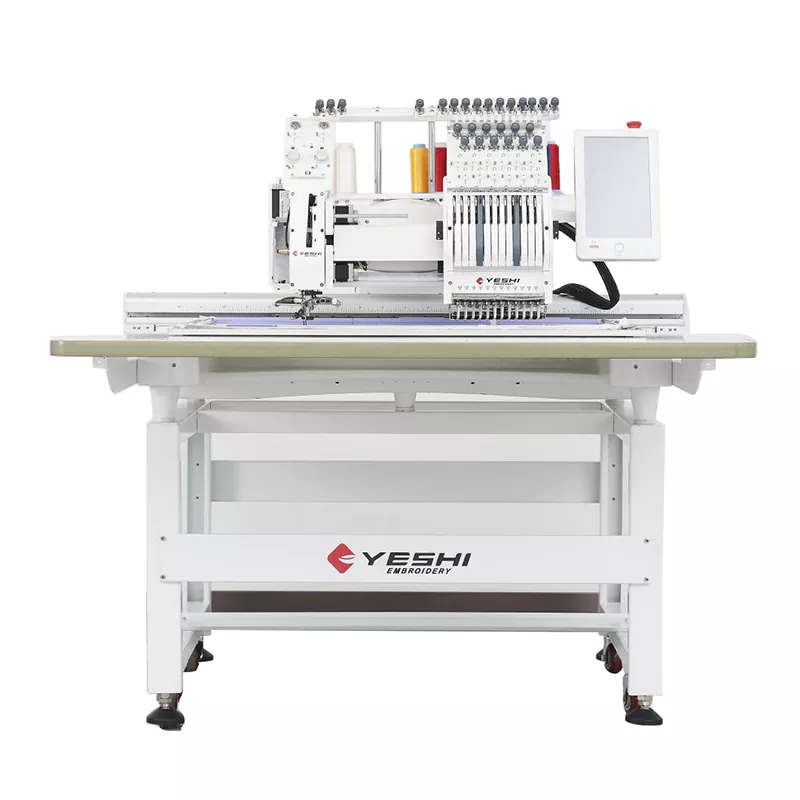
Key Technical Parameters (based on mainstream single-head models):
1. Needles: 9/12/15 needles with automatic color change, supporting complex designs
2. Embroidery Field: 250×400mm to 560×360mm, covering most garments and caps
3. Speed: 750–1,300 RPM — comparable to multi-head machines
4. Memory: USB direct-read support; capacity for 12+ million stitches
5. Expandability: Optional cap embroidery, garment embroidery, sequin, and chenille attachments available
6. Industry Insight: Even large-scale factories keep at least one single-head machine on the floor — specifically for rush orders, sampling, or small runs that would be uneconomical to run on a multi-head machine.
Multi-Head Embroidery Machines: The Efficiency Engine for Mass Production
Multi-head machines come with 2 to 24 heads, allowing simultaneous embroidery on multiple items. Their core strengths are high throughput and low unit cost.
Who is it for?
Factories handling large-volume orders (uniforms, sportswear, promotional items, home textiles)
Businesses requiring stable capacity and predictable unit costs
OEM/contract manufacturing
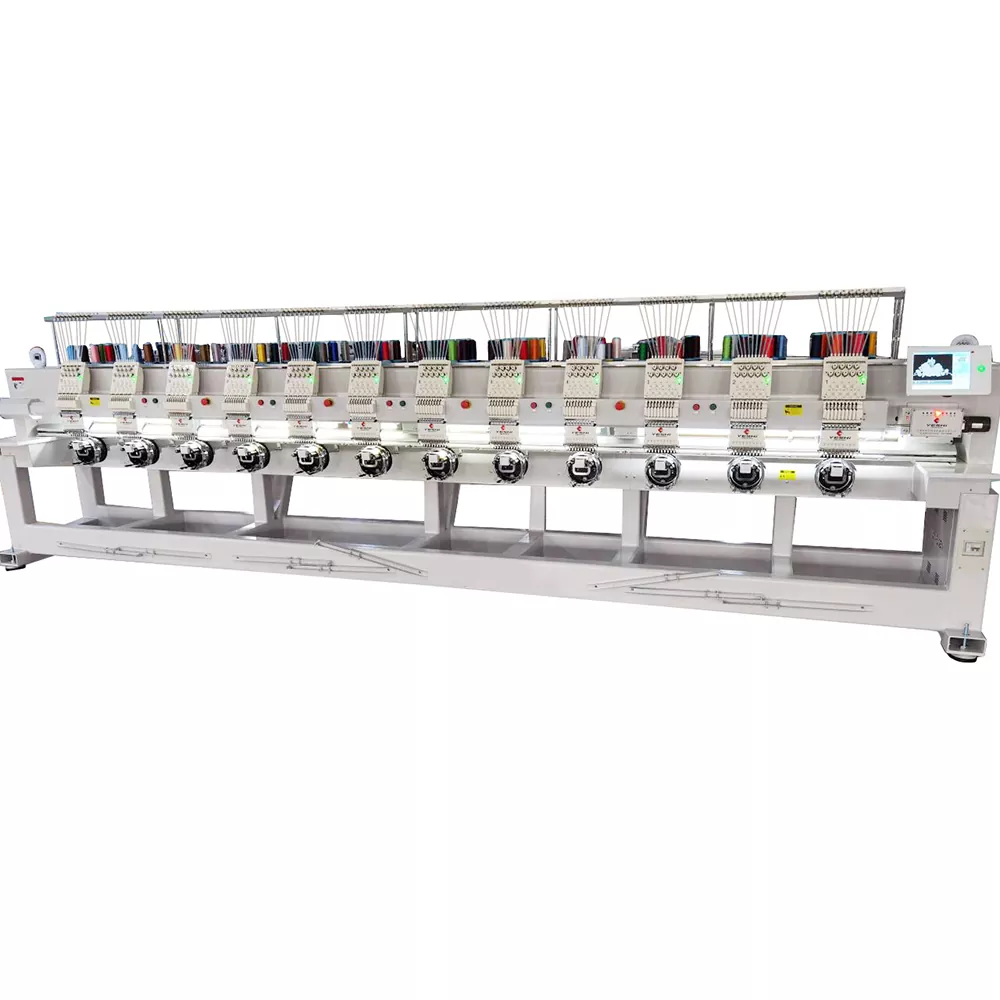
Key Technical Parameters (based on a typical 20-head industrial model):
1. Number of Heads: 15/20 heads; output scales linearly with head count
2. Needles: 6/9/12 needles with automatic color change
3. Embroidery Field: Head spacing 300–400mm; Y-axis travel 600–900mm (customizable)
4. Speed: 850–1,200 RPM; high-speed models can exceed 1,200 RPM
5. Memory: 20+ million stitches; supports 5,000+ design storage
6. Automation Features: Broken thread detection, automatic thread trimming, fault alerts, intelligent re-stitching, and power-off protection are all standard
Industry Consensus: For large contracts, multi-head is the only viable option. Per-piece embroidery costs can be driven down significantly — a decisive advantage in price-competitive OEM markets.
Format Three: The Decision Flow — Ask Yourself Three Questions
Instead of getting lost in specs, start by answering these three straightforward questions:
Question 1: What does your order mix look like?
"High-mix, low-volume" (e.g., 5 designs × 10 pieces per day) → Single-head is more efficient
"Low-mix, high-volume" (e.g., 2 designs × 100 pieces per day) → Multi-head is the clear choice
Question 2: What are your budget and space constraints?
Limited capital and tight workspace → Start with a single-head machine; lower risk and faster ROI
Sufficient budget and dedicated production floor → Invest directly in multi-head capacity
Question 3: What is your growth path?
Test the market first, build a client base, then scale up → Single-head is the ideal "explorer"
Committed to contract manufacturing and targeting large clients → Go straight to multi-head to establish a capacity moat
The Advanced Strategy: A Hybrid Approach
A mature business strategy often combines both machine types. As leading brands like Barudan have long advocated: every embroidery business needs at least one single-head machine — to handle small orders and samples, while reserving multi-head capacity for high-volume runs. Using a multi-head machine for small jobs is simply wasting money.
Combine multi-head units to form your core production capacity for bulk orders, while keeping a single-head machine dedicated to sampling, rush orders, and high-value custom work. This dual-track approach offers greater resilience and competitiveness in today's dynamic market.
Send Inquiry



X
We use cookies to offer you a better browsing experience, analyze site traffic and personalize content. By using this site, you agree to our use of cookies.
Privacy Policy